

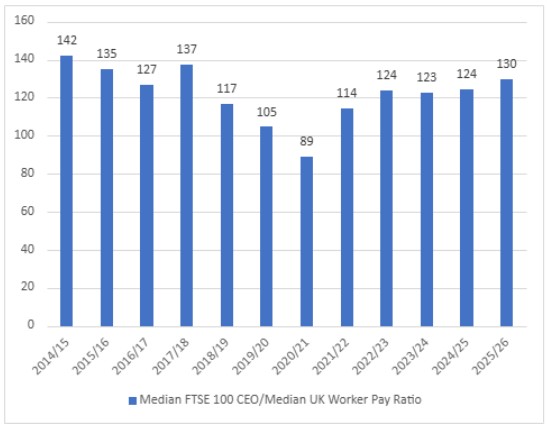
The High Pay Centre’s annual review of CEO pay in the FTSE 100 shows the Median FTSE 100 CEO to median UK worker pay ratio rose to 130:1 in 2025/26, the highest for 8 years and up from 124:1 last year
Our latest annual CEO pay report has found that the pay of the CEOs of Britain’s biggest companies increased by 8.6% in the 2025/26 financial year.
- Median pay for a FTSE 100 CEO increased from £4.66m in 2024/25 to £5.06m in 2025/26. This is the highest level of FTSE 100 CEO pay on record, and the fourth successive year that CEO pay has grown. The last four years have all been record breaking.
- Mean FTSE 100 pay dropped from £6.09 million to 5.89 million. However, this decrease can mostly be attributed to an exceptionally high pay award for Melrose Industries of £58.93m. If Melrose is excluded from last year and this year’s samples, mean pay would have increased by 6.5% from £5.53m to £5.89m
The research shows that the median FTSE 100 CEO is now paid 130 times the median UK full time worker, up from 124:1 in 2024/25.
Other key findings include:
- A total of 66 firms (70%) increased their CEOs pay package from the previous year, up from 61% of firms who did so last year
- The mean LTIP payment increased 20% from £2,258k last year to £2,709k, while the mean STIP award increased 14% from £1,614k to £1,843k.
- In total, £856.6 million was spent on FTSE 100 executives, including £550.4 million on CEOs. This figure was £1bn last year, though this was skewed by the £212 million paid to executives at Melrose
- The median total spend on executives by a company was £7.47 million, up from £6.74 million last year
- Currently 10 FTSE 100 companies have female CEOs. This is one fewer than last year. In three of these cases, however, they only became CEO part way through the year, while Liv Garfield was replaced at Severn Trent by James Jesic.
Our report argues that excessive spending on top earners by leading firms often comes at the expense of pay increases for the rest of the workforce. We are calling for reforms to regulations affecting corporate pay-setting process including:
- Implement the Employment Rights Act in full, including measures ensuring that workers are informed by employers of their trade union rights, and guaranteeing unions reasonable access to workplaces. Research shows that higher trade union membership and collective bargaining coverage are linked to reduced pay inequality.
- Include worker directors on company boards –A right for workers to elect at least two directors to company boards would improve operational understanding of the business at boardroom level, enhance accountability, and encourage a focus on long-term company success over short-term shareholder profit.
- Reform corporate reporting on pay –even though companies’ annual reports now typically run to hundreds of pages in length, they rarely contain fundamental information on who works for company and what they are paid. Regulations should require consistent disclosure on the pay of top earners beyond the CEO, and greater transparency on pay levels throughout the workforce, including the number of workers paid less than a living wage. If workers, investors and other stakeholders have more transparent information about pay practices, they are likely to be able to influence them to ensure fairer outcomes.
- A ‘Fat Cat Tax’-away of directly addressing extreme pay inequality between executives and workers could be a new ‘Fat Cat Tax’, whereby firms would pay a corporation tax surcharge on their yearly profits if single-figure remuneration for an executive director exceeds a specified multiple of the median UK worker’s salary. This would be a progressive system, starting with a small tax on those pay packages that exceed 10:1, before increasing in size at thresholds of 50:1, 100:1, 200:1 and 500:1. Not only would this incentivise firms to scale back the levels of corporate wealth flowing to a small handful of individuals but also could be used to raise funds to be invested in education and early years provision, helping to tackle inequality at source.